

More impressions don’t necessarily mean more people have seen your post. Instagram reach counts each account once, even if that person views the same post multiple times, so understanding how to increase Instagram reach starts with knowing what the metric measures.
It’s easy to focus on likes or repeat views when the real goal is reaching new, relevant audiences. Learning how to increase Instagram reach starts with creating content that earns attention and gives people a reason to interact, share, or discover more.
This guide explains what reach measures and how it differs from impressions. It covers how hashtags, interactive Stories, and discovery features can help increase Instagram reach, and what a professional growth strategy should prioritize.
Key Takeaways
- Separate unique accounts reached from repeat views to understand whether content is expanding its audience.
- Build hashtag groups around the post’s topic and audience instead of relying on broad tags alone.
- Use interactive Stories and discovery features to invite participation and help relevant audiences find your content.
- Align creative content and collaboration choices with your reach goals, then assess performance using the right metric.
1. What is Instagram reach?
Instagram reach is the number of unique accounts that see a post, Reel, or Story. If one person views the same post repeatedly, that account still counts once. For brands in Nepal, reach indicates how widely content travels beyond existing followers. It is not the same as posting frequency: publishing more often does not automatically mean more people discover the brand.
Reels can reach people through recommendations, while carousels give viewers several frames to explore. Stories support brief, interactive contact with existing audiences, and collaborations can introduce content to another account’s community. No format guarantees the widest reach. Choose based on the content goal, audience, and conversation you want to prompt.
For influencer and brand collaborations, professionals match a creator’s subject matter and audience with the brand’s message. They agree on the concept, deliverables, and publishing plan before production. For example, a Nepal-based food brand could work with a local food creator on a short tasting Reel, then use audience responses to shape follow-up content. Instagram Collabs lets the original author invite up to 20 collaborators, so a shared post can appear across participating profiles.
To find suitable posting times in Nepal, review account Insights and compare when followers are active with the reach of past posts. Test different time slots with similar content, then adjust your schedule based on account performance rather than assuming there is one universal peak hour.
Posting frequency should match the production plan and audience response. A practical starting cadence is 3-5 times per week, with varied formats and consistent quality. Professionals track reach across posts, then refine the schedule when content starts to lose relevance or consistency.
Spam-like repetition, automated engagement, and engagement bait can undermine authentic conversations. Avoid bought interactions and repetitive captions; prioritize relevant posts that invite genuine responses. Assess audience quality alongside reach, because inflated activity from bots does not build meaningful discovery.
2. Hashtag strategy
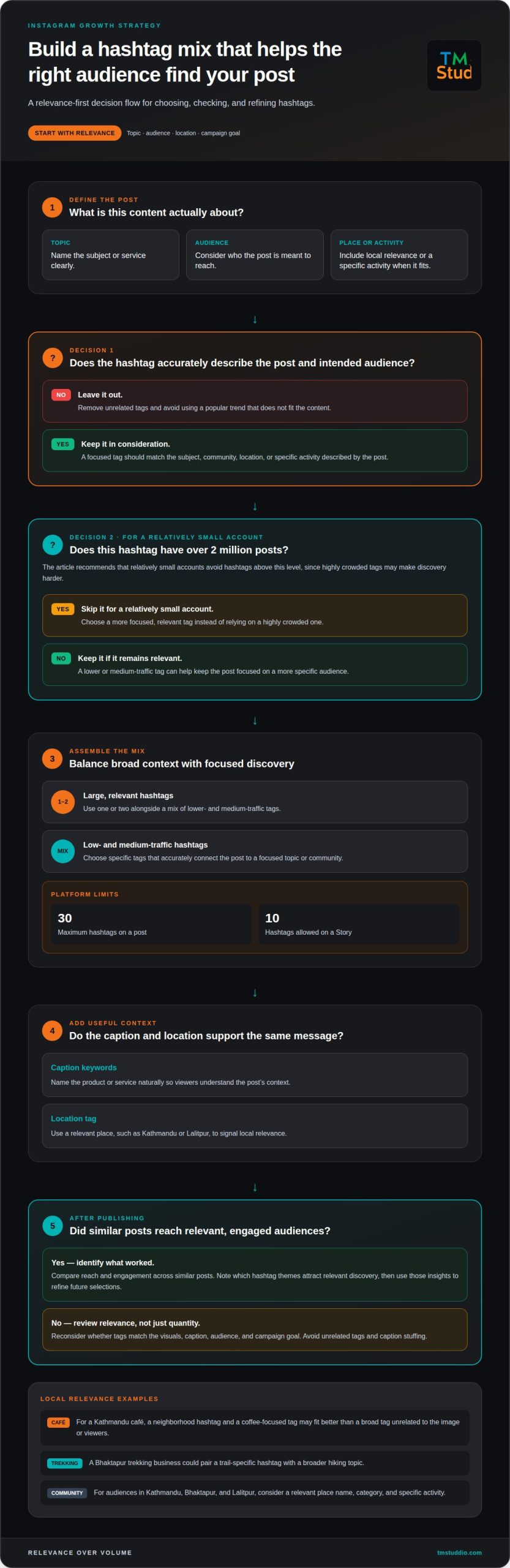
Use hashtags selectively so each tag serves a purpose. Professionals research phrases linked to the post’s subject, audience, and location, then remove tags that attract unrelated activity. For a Kathmandu café, a neighborhood hashtag and a coffee-focused tag may fit better than a broad tag with little connection to the image or its intended viewers.
Start hashtag research with the content itself. Identify its main topic, target audience, and campaign objective, then review hashtags used in relevant posts and conversations. For example, a Bhaktapur trekking business might pair a trail-specific hashtag with a broader hiking topic. This describes the post clearly without filling every available slot with generic travel terms.
Hashtags work best alongside clear caption keywords and location tags. A caption that naturally names a product or service gives viewers useful context. A location tag can connect a post with a place such as Kathmandu or Lalitpur. Together, these elements help audiences understand the content and recognize its local relevance.
For creators and businesses serving Kathmandu, Bhaktapur, and Lalitpur, tailor hashtags to the intended community. Combine a relevant place name, category, and specific activity, then review which posts attract engaged local audiences. Shares can extend a post’s visibility, but each hashtag should accurately describe the content rather than chase a popular trend.
Research continues after posting. Professionals compare reach and engagement across similar posts, identify which hashtag themes attract relevant discovery, and refine future selections. They avoid unrelated tags and caption stuffing because relevance matters more than quantity. A consistent Instagram content strategy connects hashtag choices with visuals, captions, and campaign goals, giving each post a focused message.
Instagram allows up to 10 hashtags on a Story, and users can use a maximum of 30 hashtags on a post. For a relatively small Instagram account, the author recommends avoiding hashtags with over 2 million posts, since highly crowded tags may make discovery harder. The author recommends using one or two large hashtags alongside a mix of low- and medium-traffic hashtags. This mix can keep a post connected to broad topics while also making room for more focused audiences.
3. Use interactive Stories and discovery features
Instagram ranking systems use signals such as past interactions, content relevance, and likely interest to shape what people see. Professionals build for those signals with useful posts that invite real responses, rather than treating every follower as equally interested. Stories remain available for 24 hours, creating a timely space for updates, questions, and audience feedback.
Interactive stickers give Stories a clear participation prompt. A Kathmandu restaurant could use a poll asking followers to choose between two menu ideas, then share the result in a follow-up Story. A question sticker can collect customer queries for a short answer series. Keep each prompt relevant to the brand so replies become part of an ongoing conversation, not a request for empty engagement.
Comments can signal interest and provide useful language for future content. Respond to a specific question with a helpful answer, then consider turning the topic into a photo carousel or short Reel. This supports meaningful conversations and gives followers a reason to return. Avoid generic engagement bait: a prompt should help the audience express a genuine preference or need.
Discovery features can extend visibility beyond current followers. According to Buffer, Instagram Reels reached 125% more people than single photos in its analysis from January 2022 to October 2024. Professionals can adapt that insight by testing relevant Reels alongside carousels, then comparing which format brings engaged viewers and meaningful comments for the account.
To grow without paid promotion, pair useful content with clear prompts and consistent responses. A Nepal travel creator, for example, could post a route-planning Reel, ask followers which detail they want explained, and answer selected questions in Stories. This sequence links discovery, interaction, and follow-up content. Track reach and audience responses for each format, then refine future posts around themes that earn genuine interest.
Engagement can help Instagram present posts to relevant audiences. Make discovery part of your review process: note which prompts lead to thoughtful replies, then use those audience cues to shape related Stories and posts. Keep the focus on relevance. A clear question, a useful answer, and a natural next step make each interaction more valuable for both the audience and the account.
4. Instagram reach versus impressions
Reach counts unique accounts that saw content; repeat views do not add another account. If one person sees the same post three times, reach still counts one account. Impressions traditionally counted each display, so repeated exposure could increase that total. This distinction helps brands in Nepal separate new audience discovery from repeated visibility.
Instagram replaced impressions with Views as its main metric in August 2024. That change makes metric labels important when comparing reports from different periods. A campaign report using older impressions data won’t match a newer Views figure automatically. Professionals identify the metric and reporting period before judging whether a post reached new accounts or appeared repeatedly.
Consider a Kathmandu retailer whose product post reaches existing followers several times. A higher Views count may indicate repeated exposure, but it does not prove broader organic discovery. If reach grows among accounts outside the current community, the content is appearing to more unique people. Both patterns can matter, but they answer different questions about visibility.
Interpret metrics alongside the content and account context. Compare reach and Views for similar posts, then check whether profile visits, saves, shares, or comments also changed. For example, a travel brand can assess whether a route Reel attracted new accounts, while repeat Views may suggest existing followers watched again. These signals guide creative decisions without making one number stand in for the whole result.
Use reach to assess audience expansion and Views to understand total exposure. Then connect each measure to the post’s purpose: discovery, repeat awareness, or community response. This distinction strengthens decisions about future visuals and publishing formats. To align creative assets with a measurement plan, develop a visual content strategy built around the outcomes your Instagram account needs to track.
TM Studio
TM Studio helps businesses connect Instagram content with a broader digital marketing strategy. When reach is uneven or visuals aren’t supporting the message, its social media marketing and content creation can bring planning and creative execution together. Photography and videography can produce assets for posts, Stories, and Reels, while performance marketing and 360° Ads Boost support paid promotion when it fits campaign goals. Search Engine Optimization can complement social activity by strengthening visibility across digital channels. The right mix depends on the brand’s audience, content needs, and objectives, not on posting more for its own sake. For a focused approach to Instagram visibility in Nepal, contact TM Studio to discuss your goals.
Turn Instagram visibility into a focused growth plan
The next step in learning how to increase Instagram reach is to connect content decisions with a clear business objective. Decide what your account needs to achieve, then shape the creative direction and measurement around that goal. A consistent approach makes it easier to learn from performance and refine the next campaign.
For businesses that need professional support, TM Studio combines social media marketing with visual production. Its Photography and Videography services create assets for Instagram, while Search Engine Optimization can support a broader digital visibility strategy. The right mix depends on your audience, brand priorities, and content needs.
Bring your goals, audience insights, and existing content into the conversation. That gives the work a practical starting point and helps align creative choices with the outcomes your business values. Contact TM Studio to discuss your Instagram strategy and map out a clear next step. Build with purpose, keep learning from your audience, and give your brand room to grow.
Frequently Asked Questions
What is Instagram reach?
Instagram reach is the count of distinct accounts shown your content. For example, if a Kathmandu hotel posts a room photo and one account sees it several times, that account still contributes only once to reach. Use the metric to understand how many separate accounts encountered the post, rather than how often it appeared on screens.
How does Instagram reach work, and what factors affect it?
Instagram distributes content across feeds, Reels, Stories, and Explore, with audience interest influencing what appears. Relevant topics, previous interactions, and genuine engagement can affect which accounts encounter a post. For a Kathmandu bookstore, a focused reading recommendation may connect with interested viewers more effectively than a general promotion. Review results by format and audience response to guide future content.