


Hire a professional when product details are hard to show accurately, your images feel inconsistent, or your brand presentation needs to reflect the quality of what you sell. Professional product photography in Nepal gives you greater control over color, lighting, styling, and backgrounds, helping customers assess products before they decide.
It’s understandable to think a quick photo is enough, especially when you know your products well. But the right image needs to communicate that knowledge to someone seeing the item for the first time. This article explains when professional photography can improve product accuracy and styling, how visuals shape brand perception, and which background choices suit different products. You’ll also see what affects image quality and how a professional shoot can support a more consistent product presentation across your digital channels.
Key Takeaways
- Prioritize accurate color and clear product details so customers can form realistic expectations before buying.
- Use lifestyle settings, models, and props to show how a product fits into everyday life without distracting from the item.
- Build a recognizable brand impression through consistent lighting, styling, and visual choices across product images.
- Choose clean or textured backgrounds to complement each product, then keep the catalogue visually cohesive.
1. Color accuracy and product representation
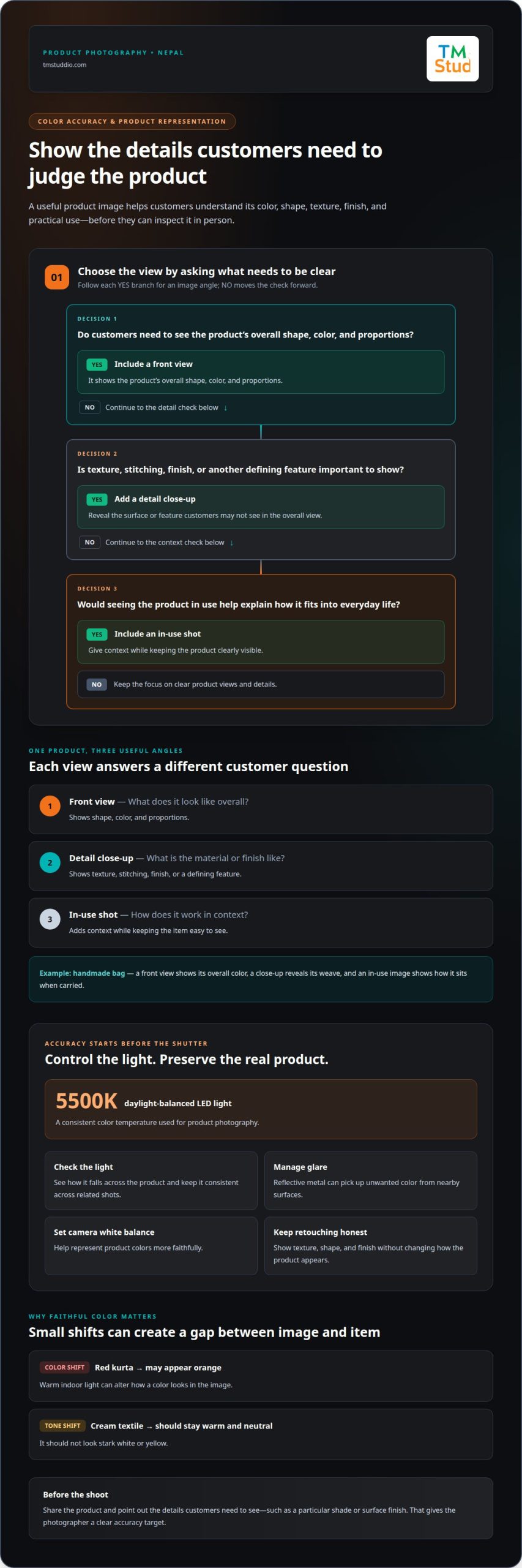
Customers judge a product from visible details before they can inspect it in person. A red kurta photographed under warm indoor light may appear orange, while reflective metal can pick up unwanted color from nearby surfaces. These shifts can create a gap between the image and the item delivered. Professional product photography Nepal brands commission can control lighting and camera white balance to represent products more faithfully. Daylight-balanced LED lights rated at 5500K provide a consistent color temperature for product photography.
Color accuracy starts before the camera captures an image. The photographer checks how light falls across each product, manages glare, and keeps lighting consistent across related shots. This matters for items with subtle shades, such as cosmetics, fabric, ceramics, or packaged foods. A cream-colored textile, for example, should retain its warm neutral tone rather than look stark white or yellow. Accurate representation also means showing texture, shape, finish, and small details without retouching that changes the product’s appearance.
- Front view: shows the overall shape, color, and proportions.
- Detail close-up: reveals texture, stitching, finish, or a defining feature.
- In-use shot: gives context while keeping the product clearly visible.
These three angles help customers understand a product’s appearance and practical details. For a handmade bag, a front view shows its overall color, a close-up reveals its weave, and an in-use image shows how it sits when carried. For businesses in Nepal, professional product photography helps keep catalogues visually consistent across different items.
Before the shoot, share the product and point out details customers need to see, such as a particular shade or surface finish. This gives the photographer a clear accuracy target. The resulting images can bring greater consistency to product pages, social posts, and catalogue visuals, making it easier for customers to compare items.
2. Lifestyle settings, models, and props
A product photographed in context can help customers picture how it fits into everyday life. A ceramic tea set, for example, feels more purposeful on a breakfast table than isolated against a plain backdrop. The setting should clarify how the product is used without competing for attention. The photographer selects a location, lighting, and framing that keep the item prominent.
Models can add scale and human context, particularly for clothing, accessories, and personal care products. A model wearing a jacket shows its fit and movement more naturally than a hanger alone. For skincare, a carefully framed application scene can demonstrate how the product is used. Casting and posing should suit the intended audience while keeping the product’s features easy to see.
In Nepal, professional product photography can cover ecommerce listings, lifestyle scenes, and catalogues. Ecommerce images focus on clear product views for online listings; lifestyle photography places items in relevant settings, while catalogue images present products in a consistent, organized format. One shoot can combine these approaches when each image has a distinct purpose.
- Settings: A tea set can appear on a dining table, while travel gear may suit an outdoor scene.
- Models: Clothing benefits from a clear view of fit, shape, and movement.
- Props: A cup beside packaged tea can establish use, but too many accessories distract.
Before the shoot, align each scene with the product’s audience and intended channel. A campaign image may need atmosphere, while a catalogue image needs repeatable framing. Props should support a specific message, such as scale or use. They should not imply features the product lacks or obscure labels, materials, and other important details.
Plan the scene around one clear idea, then keep the product as its focal point. For polished product visual storytelling, align the setting, model, and props with the image’s purpose.
3. Product photography and brand perception
Product images shape what customers expect from a brand. Consistent framing, lighting, and editing can make a catalogue feel considered, while mismatched styles may make products seem unrelated. For example, a Nepali tea brand could use a coherent visual approach across packaging, online listings, and social media. The goal is consistency, not identical images.
Product photography studios and independent photographers in Nepal offer services for ecommerce listings, lifestyle campaigns, and catalogues. Compare portfolios by product category and image style, then assess whether the work clearly shows materials, finishes, and scale. Names alone reveal little; a portfolio with relevant examples gives a more useful view of a photographer’s approach.
What a photography package includes depends on the project. A written scope can specify the number and type of images, styling, retouching, file formats, and delivery method. A catalogue brief, for example, may require consistent product angles, while a campaign may prioritize expressive scenes. Clarify whether models, props, or location work are included, since these affect production needs.
Before choosing a photographer, review examples similar to your products and intended channels. Ask how the shoot will maintain consistent composition and realistic product details. The process should also explain image editing and final file delivery, so the finished visuals support a clear, recognizable brand impression.
Clarify copyright and usage permissions in the written agreement. Specify where the images may appear, such as an online store, social channels, or paid campaigns, and whether edits or later reuse are allowed. Clear terms help ensure the images are suited to your planned marketing use.
Delivery time depends on the number of products, styling, shoot complexity, and editing scope. Agree on the schedule and review stages before production begins. Professional equipment and editing should support sharp details, controlled lighting, consistent color, and natural-looking retouching without altering product features.
Potential extra costs may relate to models, props, location requirements, additional edits, or expanded image usage. Photography pricing depends on the project, so contact TM Studio for a custom quote. Scope, styling, production needs, and deliverables shape the estimate. A clear breakdown helps you understand what the agreed package covers.
4. Choosing clean and textured backgrounds
A background influences whether customers notice the product or the scene around it. A clean white backdrop suits listings where shoppers need to inspect a product’s outline, finish, and details. A textured surface can add context, such as setting handmade pottery against a neutral, stone-like background. The choice should support the item rather than compete with it.
For a catalogue, consistency matters. Choose one or two backgrounds and use them throughout, so products feel connected even when their shapes and materials differ. A Nepali skincare range, for example, could use a clean backdrop for product listings and a restrained natural texture for selected campaign images. Repeating those choices creates a recognizable visual system across the catalogue.
Clean backgrounds work well when product edges or packaging need to stand out. A white foam core board can provide a simple, even surface for smaller items. Textured backgrounds help when material and setting add meaning: wood can complement a carved object, while fabric can suit a clothing accessory. Keep the texture subtle enough that labels and product features remain clear.
- Match contrast: A pale product needs enough tonal separation from a light background.
- Control pattern: Busy grain or strong patterns can pull attention away from packaging.
- Check reflections: Glossy products may reflect nearby surfaces, changing the background’s appearance.
During production, the photographer checks how each background interacts with the product’s shape, color, and finish. A reflective bottle may need a carefully positioned surface, while a woven item can benefit from a texture that echoes its material. For a consistent catalogue, backgrounds should also support similar framing and cropping across products.
Set the visual direction before the shoot by identifying where images will appear and what each image must communicate. If you want a cohesive catalogue with deliberate background choices, plan product photography content around your brand’s visual style.
TM Studio: Photography
TM Studio creates product photography that presents items clearly and consistently across digital channels. Its Photography service suits businesses whose product images need more intentional styling, accurate representation, or a cohesive visual direction for a catalogue or campaign.
Share the products, intended channels, and details customers need to notice. This gives the shoot a clear focus, whether you need ecommerce-ready views, lifestyle imagery, or consistent catalogue visuals. Photography can also complement content creation, while Search Engine Optimization can support the wider visibility of product content.
Choose a visual approach that reflects your brand and gives each product room to stand out. Contact TM Studio to discuss your product photography needs.
Build your next product story
Think beyond a single campaign image. A planned visual library can support future launches, seasonal promotions, and channel updates with a coherent foundation. Start by defining the products and audience you want to reach, then shape imagery around each product’s role in your business.
For businesses seeking professional product photography in Nepal, the next step is turning that direction into a practical content plan. TM Studio offers Photography, Videography, and Search Engine Optimization, helping businesses create visual assets alongside efforts to improve online visibility. Choose the support that fits your priorities, then share your product ideas and intended channels.
Discuss your product photography plans with TM Studio, and take the next step toward a stronger, more distinctive product presence.
Frequently Asked Questions
When should I hire a professional instead of doing it myself?
Hire a professional when a catalogue needs consistent styling, a launch calls for a planned visual direction, or products have reflective, transparent, or intricate surfaces. Glassware, for example, can show distracting reflections without careful lighting. Professional support also makes sense when producing images takes time away from sales or fulfillment. Businesses serving Kathmandu, Bhaktapur, and Lalitpur can use consistent product visuals across their digital channels.
How does a professional product photographer choose between natural and artificial light?
The photographer chooses lighting based on the product, setting, and need for repeatable results. Natural light can suit lifestyle scenes that benefit from an ambient feel, but it changes with the weather, time, and window direction. Artificial light offers more control for consistent catalogue shots or products that need carefully managed highlights. Because mixed light sources can create inconsistent color, the setup should match the intended look.
How do professional product photographers configure camera settings for accurate product colors?
They keep white balance and exposure consistent, then adjust them to the light and product surface. A typical product setup may use an aperture between f/8 and f/11 and ISO 100 or 200 to capture clear detail with limited image noise. A neutral reference card can help assess color during editing. The photographer also reviews the finished image to avoid edits that alter the product’s actual shade.
Why does lighting matter more than megapixels in product photography?
Lighting determines whether a camera captures useful color, texture, shape, and detail; more megapixels mainly capture more image information. A high-resolution image can still look dull or misleading if shadows hide a label or glare obscures a finish. Well-directed light, for example, can reveal a fabric’s weave clearly, while extra resolution cannot fix uneven lighting.