

What if an agency that won’t promise a fixed ROAS gives you a clearer plan? In performance marketing in Nepal, ROAS is a target to measure and optimise toward, not a guaranteed outcome. Results depend on factors such as your offer, audience, tracking and sales process.
It’s reasonable to expect clear answers before committing a budget: what you’re paying to achieve, how progress will be measured, and what happens when a campaign underperforms. A sound strategy makes these decisions clear instead of relying on big promises.
This article explains how performance marketing differs from broader digital marketing, what weekly optimisation and reporting should cover, and how to set a budget around acceptable acquisition costs. You’ll also learn what to look for when choosing an agency in Nepal, so you can assess its process, transparency and fit with your business goals.
Key Takeaways
- Separate performance marketing’s measurable campaign goals from the broader work of building a digital presence.
- Use weekly reviews to spot changes in lead quality and guide adjustments to creative, audiences and bids.
- Set acceptable acquisition costs around your margins and sales process, not a generic return-on-ad-spend target.
- Assess an agency by the clarity of its reporting, optimisation approach and alignment with your business goals.
How a performance marketing agency optimises campaigns and reports results weekly
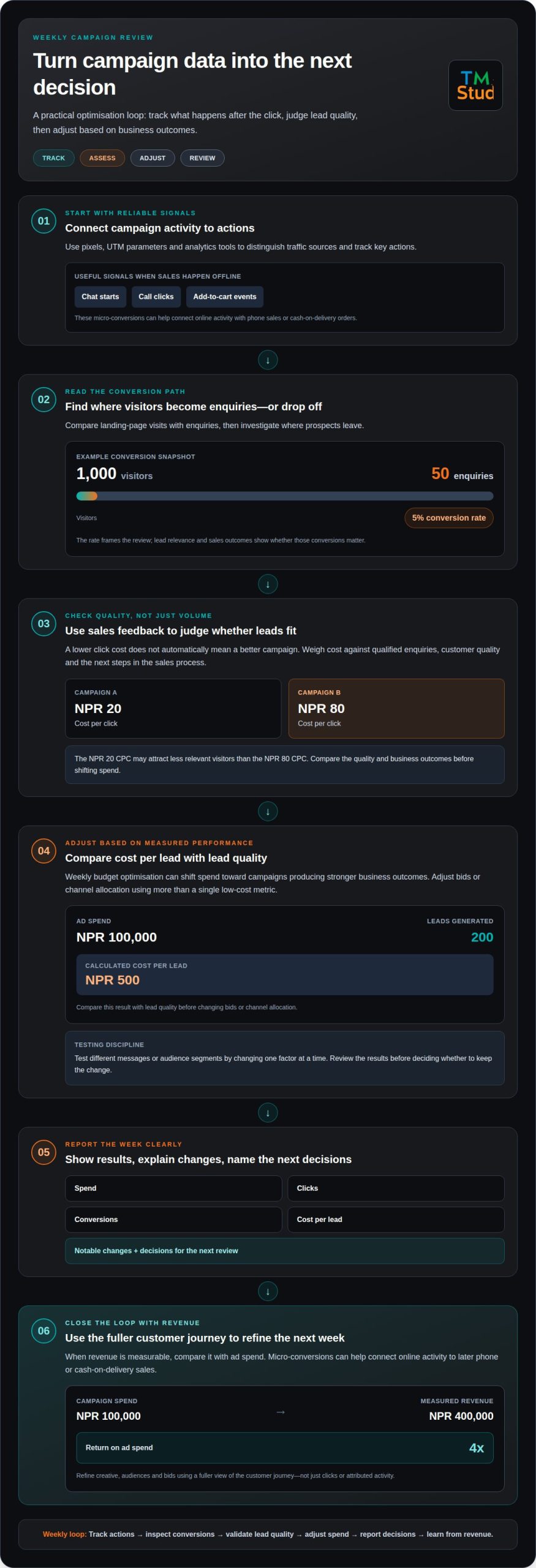
A weekly campaign review turns clicks and enquiries into decisions. In Nepal, agencies can use tracking data to adjust creative, audiences, bids and budgets.
Conversion Improvements
Conversion optimization examines what happens after someone clicks, not just how many clicks arrive. An agency can compare landing-page visits with enquiries, then identify where prospects leave. For example, 1,000 website visitors and 50 enquiries equal a 5% conversion rate. That figure helps frame a review, while lead relevance and sales outcomes show whether those conversions matter.
Agencies can test different messages or audience segments, changing one factor at a time. They then review the results before deciding whether to keep the change. For campaigns that rely on phone sales or cash on delivery, chat starts, call clicks and add-to-cart events can reveal useful early actions.
Budget Adjustments
Weekly budget optimization shifts spend toward campaigns producing stronger business outcomes. A lower cost per click isn’t automatically better: a campaign with a NPR 20 CPC may attract less relevant visitors than one with a NPR 80 CPC. The agency weighs click costs against qualified enquiries, customer quality and the next steps in the sales process.
For example, NPR 100,000 in ad spend generating 200 leads means a NPR 500 cost per lead. The agency can compare that result with lead quality before adjusting bids or channel allocation. Changes should follow measured performance, not a single low-cost metric.
Reliable reporting connects campaign activity to outcomes. Agencies can use pixels, UTM parameters and analytics tools to distinguish traffic sources and track key actions. A weekly report should show spend, clicks, conversions, cost per lead and notable changes, along with decisions for the next review.
Revenue tracking adds another layer. If a campaign spends NPR 100,000 and generates NPR 400,000 in measured revenue, its return on ad spend is 4x. When Nepal businesses close sales by phone or accept cash on delivery, micro-conversions help connect online activity with later sales. The agency can then refine creative, audiences and bids using a fuller view of the customer journey.
Planning a performance marketing budget and setting acceptable acquisition costs with an agency
Start with the sales outcome, then work backward to a media budget. An agency specializing in performance marketing Nepal should connect targets to contribution margin, enquiry-to-sale close rate and twelve-month customer value. Together, these inputs show how much a business can spend to acquire a customer while protecting profitability. A large revenue target alone doesn’t establish an affordable acquisition cost.
For example, a business converting 20% of qualified leads into customers needs approximately 100 qualified leads to acquire 20 customers. The agency can calculate the maximum acceptable cost per lead from the customer acquisition ceiling and close rate. In practical terms, maximum cost per lead equals acceptable acquisition cost multiplied by the lead-to-customer conversion rate.
Next, the agency translates the lead target into a media budget using the acceptable cost per lead. If the expected cost exceeds that ceiling, it can refine the audience, campaign message or channel mix before scaling. New campaigns often start with one or two channels, making it easier to compare search intent with social media discovery.
Return on ad spend needs context. A 3x return may be excellent for one company and unprofitable for another, while a 2.5x return may produce strong profit under different economics. The agency should compare attributed revenue with contribution margin, fulfilment costs and repeat purchases, rather than treating one ROAS target as universal.
Budget reviews should also separate media spend from agency fees and other campaign costs. Ask for targets tied to qualified enquiries or sales, plus a plan for reallocating spend when lead quality changes. A performance campaign planning approach can connect those targets with audience, creative and channel decisions. Set a learning budget the business can sustain, then scale only when conversion quality supports it.
Choosing a performance marketing agency in Nepal
Choose an agency by how it connects campaign decisions to business results. For performance marketing in Nepal, look for a clear process covering audience, tracking, creative, reporting and sales follow-through. A polished pitch matters less than an approach that explains what will be measured and how findings will inform the next decision.
Start with the ROAS question. Treat a promised return as a target, not a settled outcome. Ask the agency to explain the assumptions behind its projection, including conversion tracking, average order value, margins and sales attribution. For example, revenue credited to an advertisement may look strong while enquiries fail to become customers. A sound plan distinguishes attributed activity from confirmed business outcomes.
Use these checks to assess the agency’s working approach:
- Measurement: Ask how it tracks enquiries, purchases and lead quality across campaign sources.
- Audience strategy: Look for a reasoned link between customer intent, targeting and channel choice.
- Creative process: Ask how messaging and visual variations are assessed against campaign goals.
- Reporting: Expect clear results, explanations for changes and specific next actions.
Then assess how the agency learns from your sales team. A campaign may generate enquiries, but staff feedback can reveal whether those leads match your ideal customer. Agree on what counts as a qualified enquiry, how sales outcomes feed into campaign reporting, and who provides that information. This keeps optimisation focused on meaningful progress, not surface-level activity.
Ask for a sample reporting format or a walk-through of a past campaign’s decision process. The useful detail is not a competitor’s confidential data, but the sequence: what the agency observed, what it changed and how it judged the result. Also clarify who approves creative, how audience changes are explained, and how campaign access and reporting are handled.
Finally, align expectations before launch. Define business goals, responsibilities, reporting cadence and the process for revising targets. Choose an agency that explains its reasoning plainly and connects each campaign action to your commercial priorities.
What performance marketing services are available in Nepal?
Performance marketing combines paid campaign delivery with measurement and ongoing improvements. Depending on the business goal, an agency may manage search advertising, paid social campaigns, creative production, tracking and conversion optimisation. Campaigns may be measured against actions such as clicks, sign-ups or purchases, so objectives should shape the service mix.
Common service components include:
- Paid search: Campaigns reach people actively looking for a product or service. Agencies organize keywords, advertisements and landing-page journeys around relevant intent.
- Paid social: Audience targeting and creative variations help introduce offers to potential customers. Campaigns can be assessed by the actions they generate, not reach alone.
- Creative testing: Different messages, visuals and calls to action are compared. The results guide which assets to refine or continue using.
- Measurement and optimization: Tracking connects campaign sources with enquiries, sign-ups or purchases. Reports then inform changes to targeting, creative and spend.
Choose the combination based on the customer journey. For example, a business with strong search demand may prioritise intent-led campaigns. A new product may need social media creative to build awareness before prospects are ready to enquire. The agency should explain how each channel supports the objective and what action counts as progress.
Performance marketing also works alongside broader digital activity. Search Engine Optimization can build visibility through unpaid search, while paid campaigns can capture immediate demand. Content gives advertisements useful messages and visuals. These activities serve different roles, so reporting should distinguish paid outcomes from longer-term visibility and content engagement.
For a Nepal campaign, the service scope should clarify who develops creative, how tracking is set up, and what the reporting covers. It should also explain how campaign adjustments follow observed audience response. If you’re ready to connect campaign goals with a practical service mix, discuss your performance campaign.
TM Studio: Performance marketing
TM Studio helps businesses turn campaign goals into measured performance marketing activity. Turn to the team when you need a structured approach to reach an audience, track responses and refine campaigns around business objectives.
Creative execution can support that work: Photography and Videography provide visual assets for campaigns, while Search Engine Optimization can strengthen visibility through unpaid search. Each plays a different role, so the right mix depends on your audience, offer and growth priorities.
Bring your campaign goals, target customers and current marketing context to the conversation. TM Studio can use these inputs to shape a practical direction for performance marketing in Nepal, with measurement and creative aligned to your business. Contact TM Studio to discuss your campaign goals.
Turn your next campaign into a growth plan
The next step is to connect your marketing activity with the business outcome you want to achieve. A clear campaign direction aligns audience, messaging and measurement, so each decision supports a practical commercial priority. For businesses considering performance marketing in Nepal, that means building a plan around their own customers and growth goals, not copying another brand’s approach.
TM Studio brings performance marketing together with complementary creative and visibility services. Search Engine Optimization can support organic discovery, while Photography and Videography provide visual content for campaigns. The right mix depends on your objectives and the role each activity should play.
Bring your campaign priorities and audience context into a focused conversation. TM Studio can help shape a direction that connects creative execution with measurable marketing activity. Contact TM Studio to discuss your campaigns, and take the next step with clarity and momentum.
Frequently Asked Questions
Do you guarantee ROAS?
No. ROAS depends on factors such as the offer, audience response, tracking quality and the business’s ability to close sales. Treat any forecast as a planning target, not a guaranteed result. For example, a campaign can report attributed revenue while the sales team is still assessing enquiries. Ask how reporting distinguishes attributed activity from completed purchases and how campaign decisions respond to that distinction.
Performance marketing vs PPC?
PPC is one advertising model; performance marketing is a broader approach that measures campaigns against defined actions or business outcomes. PPC commonly charges for clicks, while performance marketing may focus on clicks, sign-ups or purchases. For example, a PPC campaign can bring visitors to a product page, while performance measurement can also assess whether visitors enquire or buy.
Minimum ad spend?
A practical learning budget can start around NPR 800-1,500 per day per platform. The right amount depends on the audience, competition, campaign objective and how much data the campaign needs to inform decisions. A business testing a single channel has a different allocation from one running several platforms. Keep the budget sustainable while allowing enough activity to evaluate campaign performance.
What is performance marketing in Nepal?
It is paid digital promotion measured against actions such as clicks, enquiries, sign-ups or purchases. In Nepal, a Kathmandu retailer might assess whether an advertisement generates product enquiries, while a service business may track qualified calls. For performance marketing in Nepal, the selected action should match the sales process, so reports reflect useful business activity rather than attention alone.
Which performance marketing agencies operate in Nepal?
TM Studio is a Nepal-based agency offering performance marketing and 360° Ads Boost campaigns. Its services also include Social Media Marketing, Content Creation and Search Engine Optimization. For businesses operating around Kathmandu, Bhaktapur and Lalitpur, the right fit depends on campaign goals, audience and the support needed to create and manage digital advertising. Assess each agency’s approach to measurement and reporting.
How much does performance marketing cost in Nepal?
Costs depend on campaign scope, creative needs, channel mix and advertising spend. Agency management fees and platform media budgets are separate parts of the investment. For performance marketing in Nepal, TM Studio’s price depends on the case and is given after a quote request. A useful estimate should reflect the campaign objective, audience, required assets and measurement approach.