

A campaign can reach 100,000 people and still bring in zero clients. That’s why social media ads fail: reach can’t make up for targeting the wrong audience, choosing a mismatched platform, or running creative that doesn’t feel relevant. Brand backlash can deepen the damage when a campaign misses the moment or the audience’s expectations.
It’s easy to assume an ad needs a bigger budget or more polished visuals to perform. Often, a stronger approach is to align the audience, platform, message, and next step. This article explains why social media ads fail, from audience research and platform choice to creative relevance and public backlash. You’ll learn why an ad that works on one platform may fall flat on another, how promotional messaging can lose attention, and what brands can learn from campaigns that draw criticism. For businesses in Nepal, these lessons offer practical ways to make social media advertising more relevant and focused on meaningful outcomes.
Key Takeaways
- Define your audience by relevant traits such as location and interests before choosing where to advertise.
- Match the platform to your audience and business goal, since creative that works in one feed may not work in another.
- Make each ad feel relevant to the platform: lead with a clear idea, natural creative, and value before the sales ask.
- Learn from brand backlash by considering timing, context, and audience expectations before a campaign goes live.
1. Audience research and platform selection
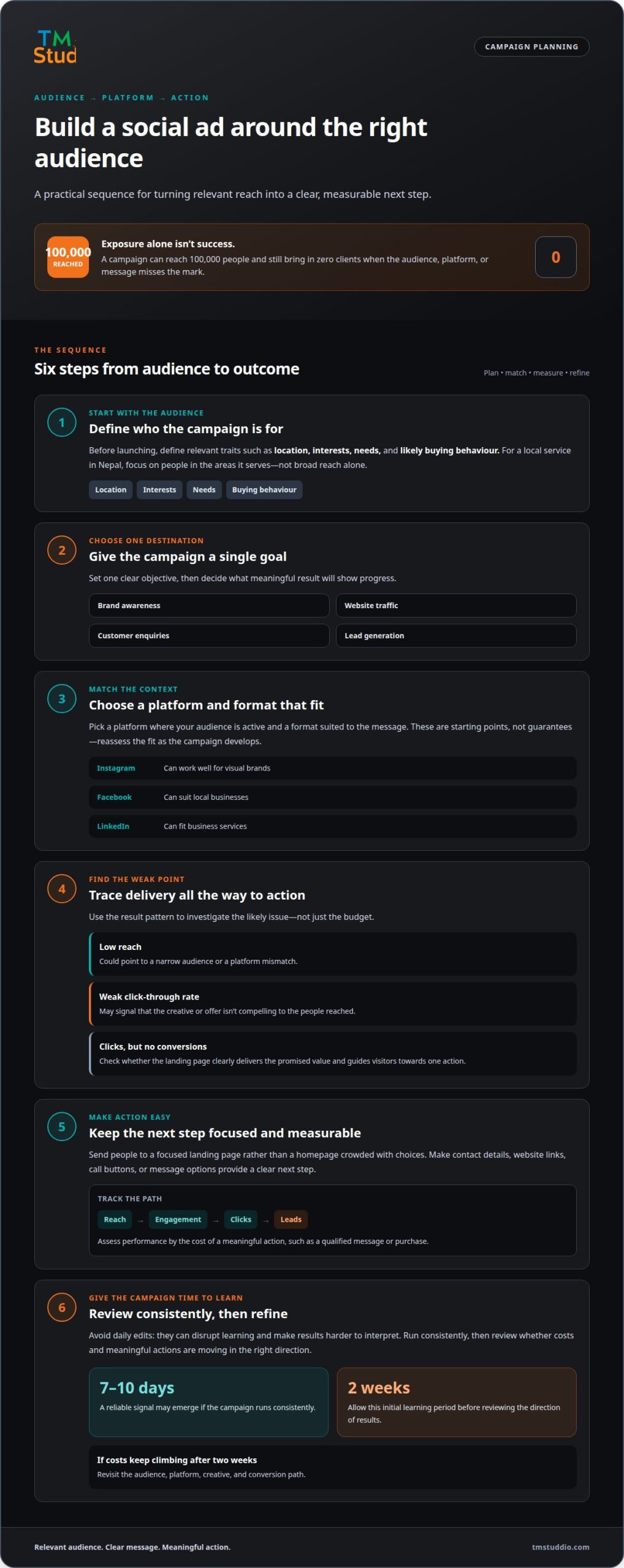
Understanding why social media ads fail starts with the audience, not the budget. Define the target audience by location, interests, needs, and likely buying behaviour before launching. In Nepal, a campaign for a local service should focus on people in the areas it serves, rather than broad reach alone. A campaign reaching 100,000 people but generating zero clients shows why exposure without relevance isn’t success.
Set one campaign goal, such as brand awareness, website traffic, customer enquiries, or lead generation. Then choose a platform where your audience is active and a format that suits the message. Instagram can work well for visual brands, Facebook for local businesses, and LinkedIn for business services. Treat these as starting points, not guarantees. Audience habits and platform features change, so reassess the fit as your campaign develops.
Diagnose weak results by tracing the path from ad delivery to action. Low reach can point to a narrow audience or platform mismatch. Weak click-through rates may signal that the creative or offer isn’t compelling to the people reached. If people click but don’t convert, check whether the landing page delivers the promised value clearly and guides visitors towards one action.
Make that path easy to follow. Direct people to a focused landing page rather than a homepage crowded with choices. Make sure contact details, website links, call buttons, or message options provide a clear next step. Track reach, engagement, clicks, and leads, then assess performance by the cost of a meaningful action, such as a qualified message or purchase.
Give a new campaign time to learn. Avoid daily edits, which can disrupt learning and make results harder to interpret. Allow the first two weeks for the initial learning period, then review whether costs and meaningful actions are moving in the right direction. A reliable signal may emerge within seven to ten days if the campaign runs consistently. If costs keep climbing after two weeks, revisit the audience, platform, creative, and conversion path.
2. What can be learned from these social media mistakes?
Platform choice shapes how people receive an ad. A business service may fit LinkedIn’s professional context, while a neighbourhood business may find Facebook more relevant for local discovery. But a platform label alone doesn’t determine fit. Consider where potential customers discuss their needs, which formats they engage with, and whether the business can meet their expectations. The right choice connects the audience, offer, and user behaviour.
Set a test budget based on the evidence the campaign needs to gather, not an arbitrary spending target. Start with the business goal, the cost of reaching a relevant audience, and the conversion action you’ll measure. A lead campaign needs enough investment to show whether people respond to its offer; a reach campaign needs a different success measure. Compare results with the value of the action, then adjust the budget based on useful evidence.
Adapt creative to the platform rather than copying one asset everywhere. McDonald’s used a “Hungry, but too tired to cook” meme in a Reddit advertisement in 2020, reflecting the community’s conversational style. That example shows why brands should consider format, tone, and audience expectations before posting. A polished promotional graphic may feel out of place in a discussion-led feed. The algorithm can also distribute ads differently as it learns from audience responses. Frequent edits change the inputs, making performance harder to interpret and weakening comparisons between versions.
Attribution can create another blind spot. Someone might see an ad on one platform, search for the brand later, then enquire through a separate channel. Platform reporting may credit only part of that journey, while privacy settings can limit the signals connecting interactions. Use consistent campaign naming and track meaningful actions across the customer journey. Compare platform reports with enquiry and sales records, while recognizing that different tools may count conversions differently.
These are practical reasons campaigns can appear ineffective: mismatched platform behaviour, unstable testing, or incomplete tracking. A disciplined review separates creative performance from delivery and measurement, giving brands a clearer basis for their next decision.
3. Creative quality and relevance in Meta ad delivery
On Meta, a viewer often judges an ad’s visual before reading its message. The opening must quickly show what’s happening and why it matters. An ad has approximately 1.7 seconds to stop a scrolling user, while its value should become clear within the first 3 seconds. A confusing opening or weak hook gives people little reason to keep watching.
Create content for the feed, not like a traditional billboard. Use conversational copy, familiar situations, and one clear idea. For example, show a customer solving a specific problem, then connect that moment to the offer. A direct call to action should make the next step clear. If the hook promises a solution but the message or action asks for something unrelated, interest can fade before conversion.
Keep the landing experience aligned, too. If an ad promises a specific service but sends people to a general homepage, visitors have to search for the details they expected. A slow-loading page adds friction before they can act. Match the landing page headline and offer to the ad, make the next step prominent, and remove distractions that compete with it.
Authenticity matters in creator marketing. Bioré partnered with a social media influencer to promote pore strips during Mental Health Awareness Month in 2023. The example highlights the need to consider context and audience expectations, not just product visibility. A creator’s role, tone, and message should feel relevant to the campaign. An association that appears forced can distract from the offer and undermine trust.
Use creative testing to improve paid ad performance and turn creative mistakes into useful signals. Compare different openings, visuals, and natural-language messages while keeping the campaign goal consistent. Review whether people watch, click, and complete the intended action. Inconsistent colours, poor-quality images, mixed messaging, or an unclear business identity can make an ad harder to recognize. A focused social media creative strategy keeps the visual, message, and landing experience working together.
4. Brand social media failures and backlash
Backlash can turn a campaign into a public test of a brand’s judgment. Gap posted a unity-themed video on Twitter the day after the 2020 U.S. presidential election. The timing placed the message inside a highly charged public conversation. The lesson isn’t to avoid every sensitive topic. Instead, assess whether the brand has a relevant reason to enter that conversation and whether its message contributes something meaningful.
Chase’s 2019 attempt to use #MondayMotivation on Twitter shows how a familiar format can still misfire. A hashtag doesn’t make a campaign feel authentic by itself. Before posting, ask whether the message fits the brand’s actions and the audience’s lived experience. If it doesn’t, people may challenge the gap between the campaign’s tone and the brand’s apparent intent.
Netflix’s 2020 promotion of Cuties demonstrates the importance of checking imagery and context. Its promotional poster showed characters who were 11 years old, and the backlash lasted for weeks. A campaign may attract attention yet generate criticism when audiences interpret its creative differently from the brand’s intention. Review each asset through the likely audience perspective, not only the internal marketing brief.
Duolingo’s owl mascot drew negative online attention over a tweet in February 2025. Mascots and playful brand voices can build recognition, but they don’t remove the need for judgment. Before publishing, identify the likely audience, the message’s context, and the action people may take. Consider whether the post invites useful interaction or risks making a serious issue seem trivial.
For brands communicating in Nepal, review local context, language, and timing before a campaign goes live. Have a response plan that identifies who reviews sensitive posts, who responds to criticism, and when a post needs pausing or clarification. Don’t treat every negative comment as a crisis; look for repeated, specific concerns. These checks can strengthen your campaign before it’s published.
TM Studio: Social Media Marketing
TM Studio helps businesses address social media ad failures with audience-focused social media marketing and relevant content creation. Turn to the team when campaigns attract attention but struggle to generate meaningful enquiries, or when creative and audience choices need a clearer strategy. Photography and videography can support distinctive visuals, while campaign planning connects the message, platform, and intended action. The focus is on building a more coherent path from audience engagement to business goals, not simply increasing exposure. For businesses in Nepal, aligning campaign content with local audiences can make communication more relevant and considered. Share your campaign goals and the challenges you’re seeing, and contact TM Studio to discuss social media marketing for your business.
Turn campaign lessons into your next move
Understanding why social media ads fail gives you a stronger starting point, but growth depends on applying those lessons consistently. Treat each campaign as a chance to learn: connect audience insight, relevant creative, and a clear business action. Use what people respond to, and what they ignore, to guide your next decision.
TM Studio can help shape that next step through Social Media Marketing, with Photography and Videography to develop campaign visuals. Search Engine Optimization can also support your wider digital visibility beyond paid social. The right mix depends on your goals and how your audience discovers your business.
Ready to make your next campaign more focused? Contact TM Studio to discuss your ads. Build on what you’ve learned, sharpen your approach, and keep moving towards more purposeful growth.
Frequently Asked Questions
What can be learned from these social media mistakes?
Social media mistakes teach brands to test assumptions before expanding a campaign. For example, if a restaurant’s video attracts comments but few table enquiries, comments alone don’t prove buyer intent. Separate attention from commercial action, review audience questions, and adjust the offer or targeting before increasing spend. This turns a weak result into a specific learning signal instead of a reason to repeat the same approach.
What is an example of a social media fail?
A hypothetical example is a Kathmandu retailer posting a jokey discount message during a serious local disruption. Even if the offer is legitimate, the tone may feel detached from customers’ immediate concerns and trigger criticism. The failure lies in poor timing and judgment, not simply low engagement. Pause scheduled posts, acknowledge specific feedback, and respond with a measured update instead of arguing in the comments.
What are the most common reasons social media ads fail?
Why social media ads fail often comes down to a combination of weak audience fit, an unclear offer, generic creative, or a disconnected customer journey. Someone may notice an ad but still lack a compelling reason to act. Check whether the message addresses a real need, the offer is easy to understand, and the next step works smoothly. A single weak link can limit the campaign’s business value.
How does poor audience targeting affect social media ad performance?
Poor targeting shows an ad to people unlikely to need or buy what it offers. For a Kathmandu tutoring service, reaching people outside its intended student or parent audience can generate views without relevant enquiries. It can also obscure useful feedback: low response may reflect an audience mismatch rather than a weak service. Define the intended customer clearly, then assess whether interactions come from plausible buyers.
What steps can businesses take to improve a failing social media ad campaign?
Start by identifying where people disengage: delivery, clicks, enquiries, or completed purchases. Next, change one element at a time, such as the opening visual, audience, or offer, so the result remains interpretable. Confirm that the destination page fulfils the ad’s promise and makes the next action clear. Record each change and its outcome, then use the pattern to guide your next campaign decision.
How do social media ad costs and performance vary by platform and industry?
Costs and performance vary with platform competition, audience size, campaign objective, creative format, and industry demand. A Kathmandu retailer targeting nearby shoppers has different delivery needs from a business promoting services across Bhaktapur and Lalitpur. Compare platforms by the cost of meaningful outcomes, such as qualified enquiries, rather than reach alone. Set the test around the business goal and audience, then adjust investment based on campaign evidence.