

A weak ad isn’t always a targeting problem. To improve paid ad performance, monitor campaign spend and top-line metrics daily, then review ad sets, placements, and audiences weekly while campaigns are live. Test at least four creative variations so you can see which combinations earn stronger results.
It’s easy to focus on clicks or spend alone, but neither shows the full picture. Better decisions come from connecting ad, audience, and conversion data, then identifying where the campaign loses momentum.
This guide explains how to test creative, refine audience segments, track conversions, and diagnose common performance problems. You’ll learn how to interpret signals such as low click-through rates and repeated exposure, and what to adjust before changing your budget.
Key Takeaways
- Monitor spending and campaign signals regularly, then test creative variations to identify what resonates.
- Refine audience segments using relevant customer insights, and use lookalike modeling to explore potential new audiences.
- Track meaningful conversions and compare attribution perspectives so campaign decisions reflect more than clicks.
- Diagnose weak results by tracing the journey from ad exposure to conversion, then adjust the part of the funnel causing friction.
1. Campaign monitoring, testing, and post-campaign review
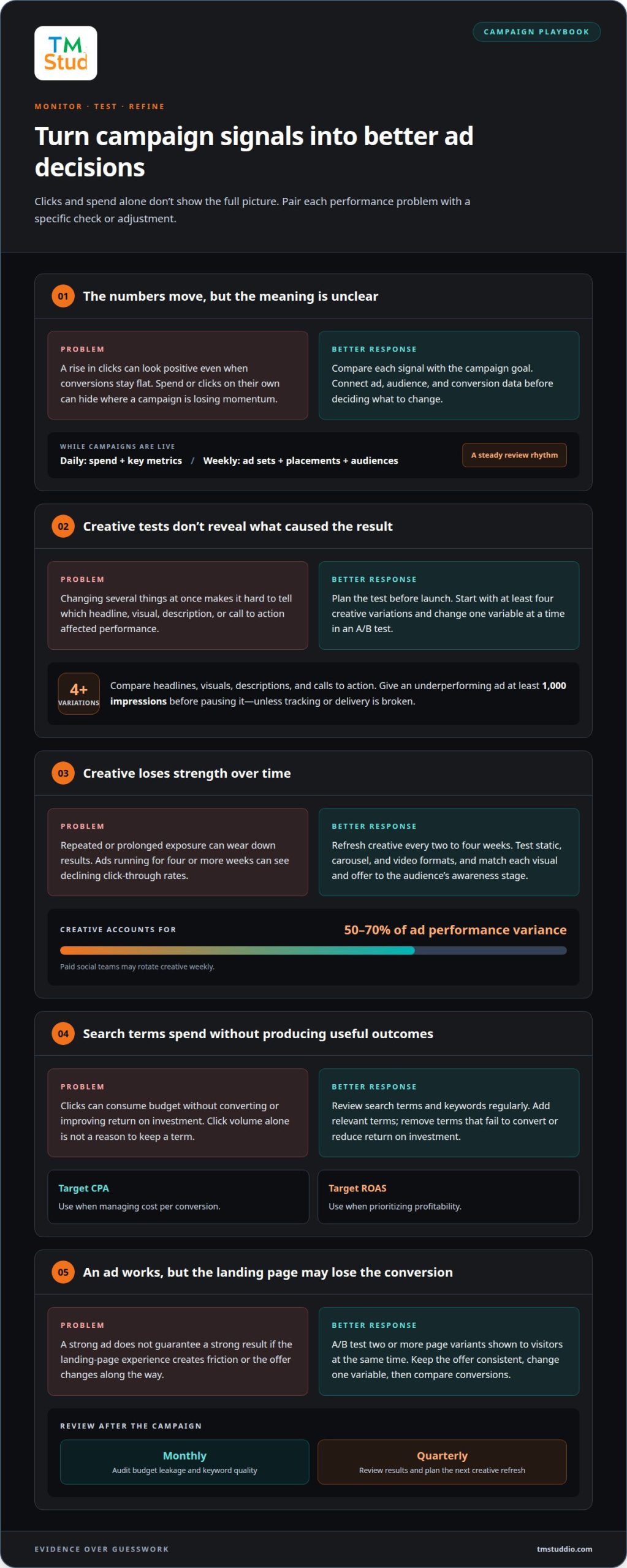
While campaigns are live, track spend and key metrics daily. Review ad set performance, placements, and audiences weekly to spot changes across platforms. A rise in clicks means little if conversions stay flat, so compare each signal with the campaign goal. This routine helps improve paid ad performance through evidence, not guesswork.
Build a clear testing plan before launch. Start with at least four creative variations for paid social, then compare headlines, visuals, descriptions, and calls to action. Change one variable at a time in an A/B test so results point to a specific cause. Give underperforming ads at least 1,000 impressions before pausing them, unless tracking or delivery is broken.
Creative matters: it accounts for 50-70% of ad performance variance. Test static, carousel, and video formats against different audience needs, then refresh creative every 2-4 weeks. Paid social teams may rotate creative weekly; ads running for 4 or more weeks can see declining click-through rates. Match each visual and offer to its awareness stage.
For Google Ads, review search terms and keywords regularly. Add relevant terms, remove those that fail to convert or reduce return on investment, and test different search ads. Set bids and budgets according to the campaign objective and conversion data: use target CPA bidding to manage cost per conversion, or Target ROAS when prioritizing profitability. Shift budget toward campaigns that produce valuable outcomes, not clicks alone.
Test landing pages as well as ads. A/B testing shows two or more page variants to visitors at the same time; keep the offer consistent and change one variable, such as the headline or call to action. Then compare conversion results. After each campaign, conduct monthly and quarterly audits to find budget leakage, assess keyword quality, and plan the next creative refresh.
2. Audience segmentation and lookalike modeling
Build audience segments around meaningful differences, not assumptions. For campaigns in Nepal, use relevant location, age, interests, and behaviors for targeting, then compare each group’s response. Platform audience insights can show which segments engage, convert, or spend without producing useful actions. Use those patterns to refine messaging and match each ad to audience needs.
Connect segmentation to business outcomes. Allocate 80% of ad spend to company types and job titles that drive the most revenue, and reserve 20% for testing new segments. For consumer campaigns, apply the same principle to customer groups that produce valuable conversions. Review the results by segment, then adjust spend and creative based on conversion quality, not reach alone.
First-party data can sharpen acquisition and exclusions. Upload segmented customer lists to Google or Meta to build lookalike audiences, which help find people with characteristics similar to existing customers. You can also exclude current customers from acquisition campaigns, reducing spend on people who already buy. Exclude existing customers from awareness campaigns when the goal is reaching new audiences.
Retargeting serves a different role: it reconnects with people who have already visited or engaged. Retargeted users are roughly 70% more likely to convert than cold audiences, so use relevant follow-up messaging rather than repeating the same ad. Keep the landing page consistent with the offer, and use tracking to compare returning visitors with new prospects.
Creative should reflect the segment, too. A short video story can show a product in use, answer a common concern, or make a service easier to understand. Match its narrative and call to action to the audience’s stage, then assess engagement and conversions. For segment-specific visuals and messaging, audience-focused content creation can support a more relevant campaign.
3. Conversion tracking and attribution
Choose conversion actions that reflect business value before launching ads. A completed purchase, qualified lead, or booked appointment each signals a different outcome. Set up tracking for those actions, then test the full path from ad click to confirmation. If a purchase event fires twice, platform reports can overstate revenue and distort bidding decisions.
Read CPA, CPL, and ROAS together. CPA measures cost per acquisition, while CPL measures cost per lead; ROAS compares advertising revenue with ad spend. A ROAS target above 3:1 can guide campaigns focused on profitability, but the right benchmark depends on margins and conversion quality. A low CPL can still mislead if leads rarely become customers.
Attribution helps explain which interactions contribute to a conversion. Last-click reporting assigns credit to the final touchpoint, potentially understating the role of earlier awareness ads. Compare first-click and data-driven attribution where available, then assess how each model changes channel and campaign decisions. Keep the model consistent during comparisons so shifting credit doesn’t appear to be a real performance change.
Privacy-conscious measurement means collecting only useful, consented customer data and handling it responsibly. First-party data can support measurement, while enhanced conversions and Meta’s Conversions API can help capture conversion signals amid browser restrictions and cookie changes. These tools complement platform tracking; still test whether recorded events match actual customer actions.
Before enabling automated bidding, validate each conversion event against a real customer journey, such as a submitted lead form or completed order. Then connect keyword analysis to attributed outcomes: review which Google Ads search terms lead to qualified conversions, add relevant terms, and remove terms that spend without useful results. This gives bidding systems clearer signals to optimize for meaningful outcomes, not just clicks. Compare reported conversions with business records to catch gaps early.
4. Diagnosing paid ad performance problems
Google Ads reaches people actively searching, while Meta Ads and other social platforms can build awareness and prompt discovery. Compare platforms by qualified conversions, not clicks alone, because audience intent and paths to action differ.
Start diagnosing with the funnel: impressions, clicks, landing-page visits, and completed conversions. A low click-through rate can signal weak creative or mismatched targeting; clicks without conversions point to the offer, page, or tracking. Check each stage before shifting ad spend, so your next step addresses the actual leak.
Budget waste often comes from broken funnels and weak offers, not just poor targeting. The Google & Meta Benchmark Study says 61% of ad accounts lose money for those reasons. Avoid the trap by matching the ad promise to the landing page, confirming that the conversion event fires, and reviewing whether leads become customers.
Then inspect frequency and clarity. Meta indicates that ads shown to the same person 3 times or more may see declining performance. Refresh the message or audience when repeated exposure coincides with weaker results. Also check whether viewers can understand the offer in 2 seconds; unclear value makes even polished visuals less compelling.
Use a diagnostic sequence instead of changing several settings at once. If impressions are low, inspect delivery and audience size. If clicks are low, test the hook, visuals, and call to action. If landing-page visits don’t convert, compare the page promise, form, and next step. If reported conversions differ from business records, review tracking before changing bids. This approach helps improve paid ad performance by linking symptoms to specific fixes.
For stronger social media creative and clearer campaign messaging, strengthen your paid social content with a focused creative strategy.
TM Studio: Performance marketing
TM Studio helps businesses turn campaign data into clearer performance marketing decisions. Work with the team when you need to connect campaign goals with audience targeting, creative, and conversion tracking, or want a more structured review of results.
Performance marketing combines testing and measurement, while photography and videography provide campaign visuals suited to your message. Search Engine Optimization can support visibility beyond paid campaigns, aligning paid and organic activity with business goals. The right mix depends on your audience, campaign objectives, and the performance signals you see.
Share your campaign priorities and where the funnel is losing momentum to start a focused discussion. Contact TM Studio to discuss your performance marketing needs.
Turn campaign insight into your next growth move
Turn campaign insights into a repeatable decision process. Choose one business priority, identify the signal that reflects progress, and use each review to decide what to refine next. This keeps new campaigns connected to wider growth goals rather than treating paid advertising as a standalone activity.
A focused creative and visibility strategy can help sustain momentum. TM Studio offers Search Engine Optimization, Photography, and Videography to support cohesive digital campaigns. Pair clear measurement with relevant creative, and use each result to inform better decisions. This approach can help you improve paid ad performance while building a more consistent path from audience attention to action.
Ready to discuss your campaigns and identify a practical next step? Contact TM Studio and keep your growth moving forward.
Frequently Asked Questions
How do you measure paid advertising performance using ROAS, CPA, and conversion rate?
Use ROAS to compare advertising revenue with ad spend, CPA to measure cost per acquisition, and conversion rate to show the share of visitors who complete the desired action. Read these metrics together: strong ROAS with few conversions may reflect a small number of high-value sales. Keep the attribution window and conversion definition consistent when comparing campaigns.
How can you improve paid ad targeting and audience segmentation?
Build segments around differences that shape the message, such as customer needs, purchase stage, or service location. For a business serving Kathmandu, Bhaktapur, and Lalitpur, compare relevant local audiences rather than treating the area as one group. Tailor the offer to each segment, then assess lead quality and completed actions before expanding reach.
Which ad creatives and copy perform best, and how should you test them?
Effective creative makes the offer clear and relevant to its audience instead of relying on a single format. Match a specific customer need with a suitable visual and direct call to action. For example, a service ad can address a common hesitation before inviting viewers to request details. Judge variations by the actions they generate, not by aesthetic preference alone.
How should you optimize landing pages to increase paid ad conversions?
Make the page deliver on the ad’s promise immediately. Use a matching headline, explain the offer plainly, and make the next action easy to find. For a lead campaign, remove unnecessary form fields and clarify what happens after submission. Check the page on mobile, where cramped forms or hard-to-tap buttons can interrupt the journey.
How can you reduce cost per click and cost per acquisition without losing conversions?
Improve relevance before lowering bids: align search terms, ad copy, and landing-page content around the same intent. Review placements and queries that attract clicks but produce no valuable actions, then exclude or refine them. Make changes gradually and monitor conversion volume alongside costs. A cheaper click isn’t an improvement if it brings less qualified traffic.
What A/B testing methods help improve paid advertising results?
Start with a clear hypothesis, such as whether a benefit-led headline will attract more qualified enquiries than a feature-led one. Run variations under comparable conditions, choose one primary outcome, and monitor a safeguard such as lead quality. Record the change and result before applying the learning to other campaigns. Don’t stop a test just because early results look decisive.