

More ad spend won’t fix a campaign reaching the wrong people or giving them the wrong reason to act. Digital ad campaign optimization means using performance data to refine targeting, budgets, copy, landing pages, and creative, aligning spend more closely with your goals.
Clicks and impressions matter most when they show whether your ads are attracting the right audience and prompting meaningful action. This guide explains how to test campaign variations, refine audience segments, reallocate budgets, improve ad copy and landing pages, and refresh creative to reduce wasted spend. It also shows why creative deserves more than a last-minute polish: the right visual and message can make every other optimization work harder.
Key Takeaways
- Test one meaningful campaign variation at a time and use enough performance data to guide decisions.
- Align audiences, ad schedules, and budget allocation with the people and placements producing the strongest results.
- Make ad copy and landing pages work as one clear path from attention to action.
- Treat creative as a performance lever: refine visuals and messaging to earn attention and support campaign goals.
1. A/B testing
A/B testing compares two versions of one campaign element to learn which performs better. Change one thing at a time, such as a headline, image, audience, or channel. For example, compare a product-focused message with a benefit-focused one while keeping the audience and placement consistent. This gives you clearer evidence for refining a campaign than changing several elements at once.
Give each version enough exposure before choosing a winner. A campaign test should gather at least 1,000 impressions or 100 conversions, depending on campaign type, before decisions are made. Compare results against the same goal and time period. If the test has too little data, an early lead may reflect chance rather than a reliable difference. Use the result to guide the next test and budget allocation.
Test creative and messaging as a connected experience. A short video may attract more clicks than a static image, while a specific headline may lead to more conversions. Track click-through rate, conversion rate, and cost per acquisition to see whether added attention leads to valuable actions. For mobile campaigns, check how each creative appears on a phone, including text legibility and call-to-action clarity. Improve paid ad performance with smarter testing and tracking by connecting creative tests with conversion data.
User testing adds context to campaign metrics. Show sample ads to intended users and ask what they understand, notice, or find unclear. Then observe whether they can complete the next step on a mobile device. This can reveal barriers that click data misses, such as confusing wording or a hard-to-find button. Use feedback to refine your test, not replace performance data.
For campaigns in Nepal, use transparent data practices, obtain consent where required, and keep advertising claims accurate. These safeguards support responsible marketing, but requirements depend on the data collected and the ad content.
Choose KPIs that match your campaign objective. Use impressions and reach to measure awareness, click-through rate for engagement, and conversions, conversion rate, and cost per acquisition to measure action. If you track revenue, return on ad spend can help assess whether results justify continued investment.
The European Union identifies fraudulent traffic and multi-channel complexity as challenges for online marketing. Structured testing can help isolate what is working across channels and flag performance that may not reflect genuine audience interest.
2. Ad scheduling, budget allocation, and audience segmentation
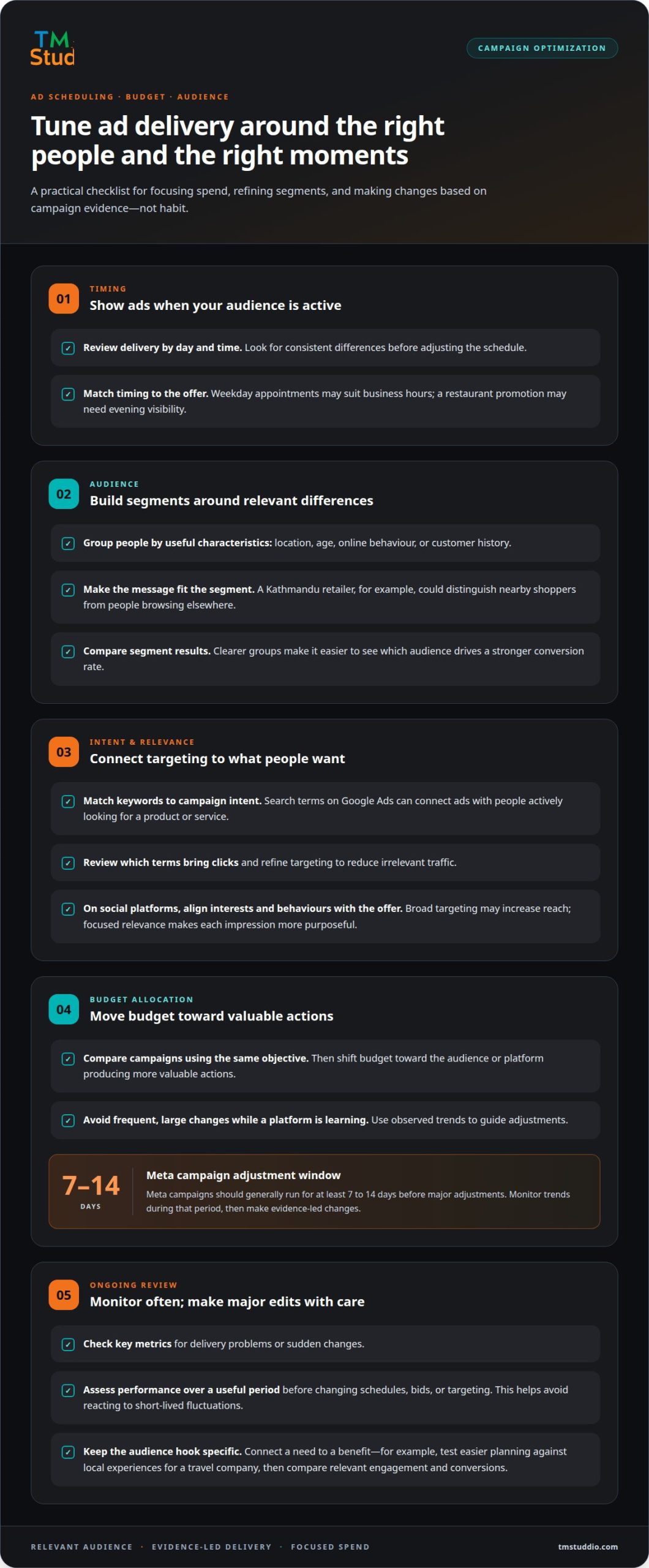
Schedule ads for the times your target audience is most active. A campaign for weekday appointments may perform better during business hours, while a restaurant promotion may need evening visibility. Review performance by day and time, then adjust delivery when the data shows a consistent difference. Scheduling helps focus spend instead of showing ads when potential customers are less likely to act.
Build audience segments around relevant characteristics, such as location, age, online behaviour, or customer history. For example, a Kathmandu retailer could distinguish nearby shoppers from people browsing elsewhere. Tailor each message to the segment’s needs. Clearer audience groups help platforms deliver relevant ads and make it easier to see which group drives a stronger conversion rate.
Match keywords and audience targeting to campaign intent. On Google Ads, search terms can connect an ad with people actively looking for a product or service. Review which terms bring clicks, then refine targeting to reduce irrelevant traffic. On social platforms, align audience interests and behaviours with the offer. A broad target may increase reach, but focused relevance makes each impression more purposeful.
Allocate budget according to performance, not habit. Compare campaigns using the same objective, then shift budget toward the audience or platform producing more valuable actions. Avoid frequent, large changes while a platform is learning. Meta campaigns should generally run for at least 7 to 14 days before major adjustments. Use that period to monitor trends, then make evidence-led changes.
Review campaigns regularly, but distinguish monitoring from major edits. Check key metrics for delivery problems or sudden changes, then assess performance over a useful period before changing schedules, bids, or targeting. This helps avoid reactive decisions based on short-lived fluctuations.
Find the audience hook by connecting its need to a specific benefit. A travel company could test messages about easier planning against messages about local experiences, then compare relevant engagement and conversions. Strong audience-focused content can make targeting more meaningful; content creation for digital campaigns can help shape messages for distinct segments.
3. Ad copywriting and landing page optimization
Make every ad promise clear, specific, and relevant to the page it opens. An ad promoting a restaurant’s lunch menu, for example, should lead to a page showing that menu, not a generic homepage. This continuity helps visitors understand what to do next and supports conversion rate optimization. Write a direct headline, explain one benefit, and use a call to action that matches the offer. Avoid claims the page cannot support.
Google Ads can reach people actively searching for products or services, while Meta Ads can introduce offers through social feeds. Other platforms may suit campaigns where their audience or content context matches the goal. Compare them using the same campaign objective and metrics, such as qualified visits or completed enquiries. In a Google Ads ad group, test 2-4 ads with different headlines and descriptions to identify stronger copy.
Improve the landing page around the action the ad asks visitors to take. Keep the headline aligned with the ad, put the main benefit near the top, and make the next step easy to find. If an ad promises a booking, show a clear booking action. On mobile, check that text is readable, buttons are usable, and key information is easy to access.
Look beyond click-through rate when reviewing campaign performance. A higher rate can still waste spend if visitors leave without taking the intended action. Track conversions and conversion rate alongside clicks, then investigate where visitors drop off. Common mistakes include sending several ads to an irrelevant page, changing copy and targeting together, or judging success by clicks alone. These choices obscure what works and can direct budget toward low-value traffic.
Use a simple improvement cycle: match the message to the page, review user actions, identify friction, and refine one element. If visitors reach a service page but don’t submit an enquiry, for example, clarify the offer and strengthen the call to action. Keep the page focused on helping visitors take the action promised by the ad.
4. Creative optimization
Creative optimization improves the message and format people see across digital advertising channels. Start with the audience’s need, then connect it to one clear benefit. A Nepal trekking company, for example, could lead with a trail image and a direct message about guided trips. The visual attracts attention; the message explains why the offer matters. A striking design without a relevant benefit can attract views without supporting the campaign goal.
Build each creative around one idea. Pair a version featuring a product benefit with another showing how customers use it. Keep the offer, audience, and placement consistent while comparing results. This makes it easier to identify whether the image, opening line, or format influenced performance. If a short video runs on social channels, make the opening understandable without sound. Keep the core message clear on mobile screens.
Measure more than views. Compare engagement with the action the campaign is designed to drive, such as a qualified enquiry or purchase. A high click-through rate may look promising, but weak conversions can signal a mismatch between the creative and the offer. Review comments and audience responses, too. Repeated questions about price or availability may show that the ad leaves important details unclear.
Use those signals to implement the next creative change. Refresh an image when it no longer reflects the offer, simplify copy when viewers miss the main point, or adapt the format for another channel. Storytelling with emotional triggers can help a digital advertising campaign gain attention, but the story must still connect to the product and next step. Keep a record of the creative, placement, audience, and outcome, then carry useful insights into the next round. Plan a creative refresh for your campaigns around the message and visuals your audience needs.
TM Studio: Search Engine Optimization
TM Studio can support your growth with Search Engine Optimization when you want to strengthen visibility beyond paid campaigns. SEO helps improve how your business appears in search, while photography and videography can supply visual assets for advertising creative. For campaign activity, 360° Ads Boost is another relevant offering.
Consider these services when your campaign needs stronger search visibility, refreshed visuals, or a coordinated approach to reaching audiences. The right next step depends on your goals, current content, and campaign needs. Contact TM Studio to discuss what you want to improve.
Make your next campaign more intentional
Turn campaign learning into a stronger plan for what comes next. Use digital ad campaign optimization to connect audience insights, persuasive messaging, and creative choices with the outcomes your business values. Focus on informed decisions, not activity for its own sake.
When you need support beyond paid campaigns, TM Studio offers Search Engine Optimization, Photography, and Videography. These services can strengthen search visibility and develop visual assets that support your marketing direction. Choose the support that fits your challenge, whether you want to be easier to find or give your campaign fresher imagery.
Bring your campaign goals and ideas into a conversation, then identify a practical next step. Contact TM Studio to discuss your campaign and shape a clearer path forward. Every thoughtful test can create a sharper foundation for your next move.
Frequently Asked Questions
What is ad campaign optimization?
Ad campaign optimization is the ongoing process of improving advertising to support a defined business objective. For a Kathmandu retailer, that could mean focusing a promotion on qualified store enquiries instead of broad attention. The objective determines what to monitor and which changes make sense. Optimization can cover delivery, messaging, audience fit, and the customer journey after someone responds.
What is digital ad campaign optimization?
Digital ad campaign optimization applies this process to advertising delivered through online channels. It uses campaign data to guide adjustments, such as revising an offer when visitors engage but don’t enquire. The aim is to make optimization a practical decision-making cycle, not a one-time setup. For a local business in Kathmandu, Bhaktapur, or Lalitpur, success depends on connecting online activity with the actions that matter to its goals.
How do you optimize targeting, audience segments, and ad placements?
Start with the customer action you want, then map the locations, interests, and behaviours most relevant to it. A Lalitpur service business might distinguish nearby prospects from people outside its service area, then tailor messages to each group. Review placements for quality, not just reach: a placement attracting unrelated clicks may need limits or different creative. Keep useful segments distinct so results remain easy to interpret.
How do you A/B test digital ads and determine statistical significance?
Compare versions that differ in one key element, such as the opening message, while keeping the audience and objective consistent. Statistical significance assesses whether a measured difference is likely to reflect a real effect rather than random variation. Don’t treat a small early lead as proof. Use an experiment tool’s significance reporting when available, and consider sample size, conversion volume, and consistency before applying the result more broadly.
How should campaign budgets and bids be optimized across channels?
Set a shared business outcome before comparing channels, since one platform may generate reach while another drives enquiries. Review each channel’s contribution to that outcome, including lead quality, then shift spending gradually toward stronger value. Check that tracking uses comparable definitions across platforms. Bid adjustments should reflect the campaign objective and delivery patterns, not isolated changes in clicks.
What tools and analytics are used to optimize digital advertising campaigns?
Start with each platform’s reporting, such as Google Ads and Meta Ads, to review delivery, clicks, and conversions. Use website analytics to understand what visitors do after clicking an ad, including which pages lead to enquiries. Consistent conversion tracking connects these views. A simple report combining channel, audience, creative, and outcome makes patterns easier to spot and helps you decide which campaign element needs attention.